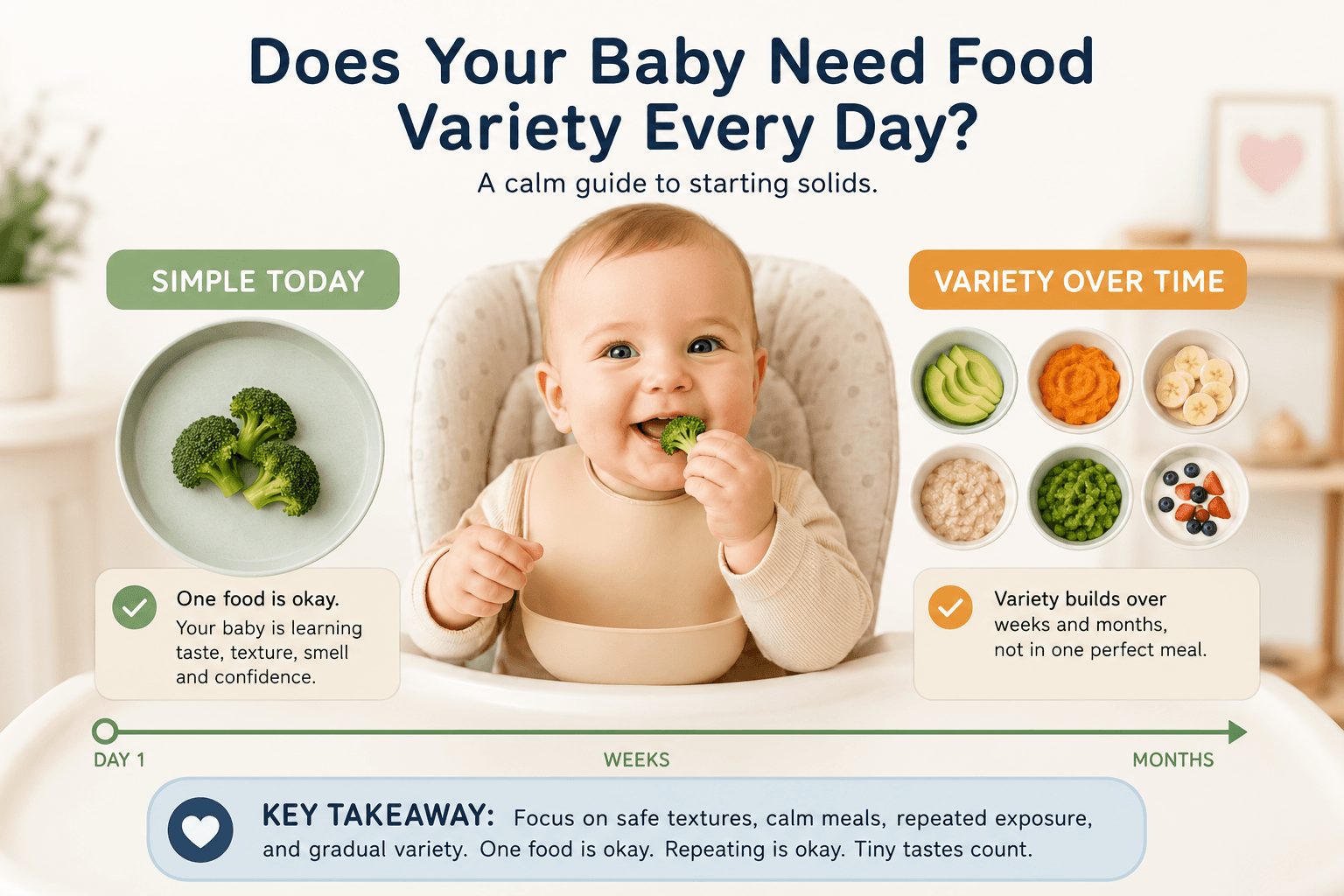
Does Your Baby Need Food Variety Every Day?
A calm guide to starting solids, repeating foods, and building variety over time.
Quick answer
Your baby does not need a different menu every day when starting solids. Variety is important over time, but simple foods, repeated foods, and tiny tastes can still support learning, confidence, and safe food exploration.
Key takeaway
Focus on safe textures, calm meals, repeated exposure, and gradual variety. One food is okay. Repeating is okay. Tiny tastes count.
Does your baby need food variety every day?
Starting solids can feel like a race.
One day you see a beautiful baby plate online with five colors, three textures, and perfectly cut pieces. The next day, you may feel behind because your baby only had banana again.
But here is the calmer truth:
Your baby does not need a perfect variety of foods every single day.
Variety matters — but it builds over weeks and months, not in one perfect meal.
Many babies begin solid foods around 6 months when they show signs of readiness. The CDC says children can begin eating solid foods at about 6 months, and introducing foods before 4 months is not recommended.
When babies begin solids, they are learning how food feels, smells, tastes, and moves in their mouth. A simple meal can still be a meaningful learning experience.
Why parents feel pressure to offer variety
Parents often feel pressure because “healthy eating” is usually shown as colorful, balanced, and perfectly planned.
But baby feeding is different.
Your baby is not just eating for nutrition. Your baby is also learning how to sit during meals, touch food, bring food to their mouth, move food around safely, accept new textures, and trust new smells and tastes.
At the beginning, a calm meal with one safe food can be more helpful than an overloaded plate.
A few bites of avocado, a soft banana spear, or one steamed broccoli floret can still be real progress.
Variety builds over time
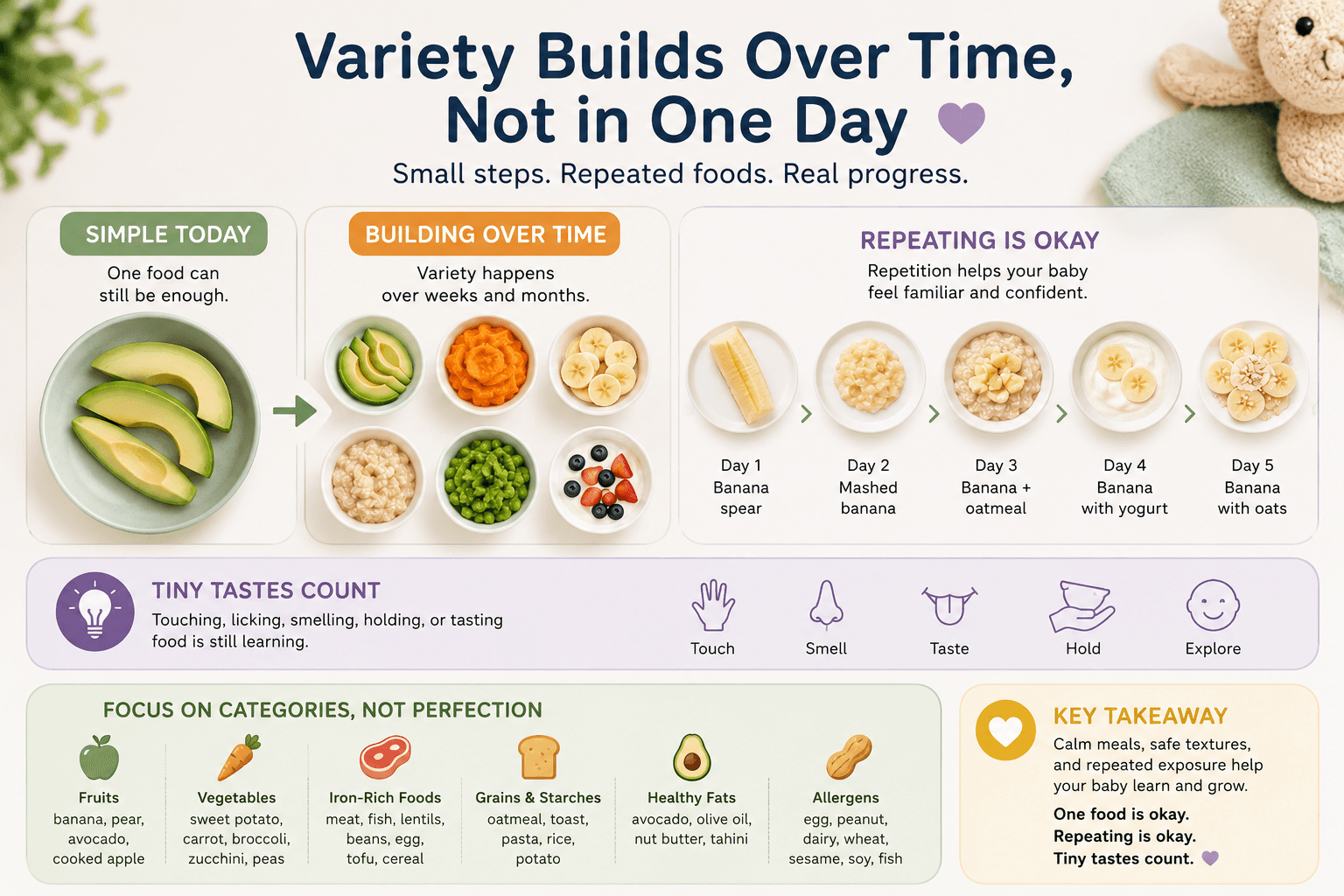
Answer: Babies do not need a completely new menu every day. A varied diet matters over time, but simple meals and repeated foods can still be part of a healthy starting-solids journey.
It is helpful to think about variety as a long-term goal.
Not:
“Did my baby eat many different foods today?”
But:
“Is my baby slowly being exposed to different foods over weeks and months?”
Some days your baby may try something new.
Some days your baby may repeat yesterday’s food.
Some days your baby may only touch the food.
Some days your baby may eat almost nothing.
That still counts as part of the journey.
The AAP encourages exposing babies to a wide variety of healthy foods and textures, but that does not mean every single meal needs to include many different foods.
One food is okay
Answer: One safe, soft food can be enough for an early meal. Babies are learning taste, texture, smell, hand-to-mouth movement, and confidence.
A simple meal can still be useful.
Examples:
avocado wedges
soft banana spears
mashed sweet potato
plain yogurt
soft oatmeal
steamed broccoli
soft-cooked carrot sticks
lentils on a preloaded spoon
One food can give your baby a chance to explore texture, smell, temperature, shape, and taste.
When the plate is simple, babies may also feel less overwhelmed.
Repeating foods is okay
Answer: Repeating foods can help babies become familiar with new tastes and textures. Repetition is not failure — it is part of learning.
Repeating foods does not mean you are doing something wrong.
A baby may need to see, touch, smell, lick, and taste a food many times before it feels familiar. Some babies accept a food quickly. Others need more time.
You can repeat foods in small ways:
banana today, banana with oatmeal tomorrow
avocado wedges today, mashed avocado on toast later
sweet potato sticks today, sweet potato with lentils next week
broccoli floret today, broccoli mixed into egg later
This gives your baby both familiarity and gradual variety.
Tiny tastes count
Answer: Starting solids is not only about how much food your baby swallows. Touching, smelling, licking, holding, or tasting food can still be part of learning.
These all count:
touching food
smelling food
licking food
holding food
squishing food
bringing food to the mouth
taking one small bite
trying the same food again another day
At the beginning, solids are a learning process. The NHS explains that babies can move from puréed or blended foods to mashed, lumpy, or finger foods as soon as they can manage them, because this helps them learn to chew, move food around their mouth, and swallow.
So even when the meal looks small, the learning can be big.
A simple way to build variety without stress
You do not need a complicated meal plan.
You can build variety slowly with a simple rhythm:
Day 1: Avocado
Day 2: Avocado again + banana
Day 3: Sweet potato
Day 4: Sweet potato again + yogurt
Day 5: Oatmeal + pear
Day 6: Broccoli + egg
Day 7: Lentils + carrot
This is not a strict rule. It is just an example.
The idea is simple: introduce new foods slowly, repeat familiar foods, and let variety grow naturally.
Focus on categories, not perfection
A helpful way to think about variety is by food groups over time.
You can gradually offer:
Fruits
Banana, pear, peach, avocado, cooked apple.
Vegetables
Sweet potato, carrot, broccoli, zucchini, pumpkin, peas.
Iron-rich foods
Meat, poultry, fish, lentils, beans, tofu, egg, iron-fortified cereal.
Grains and starches
Oatmeal, toast strips, pasta, rice, potato.
Healthy fats
Avocado, olive oil, nut butters thinned safely, tahini mixed into yogurt or purée.
Allergens when appropriate
Egg, peanut, dairy, wheat, fish, sesame, soy, and tree nuts in safe baby-friendly forms.
You do not need to cover every category every day. The goal is to slowly widen your baby’s food world.
Simple plates can be better than busy plates
A plate with too many options can sometimes feel overwhelming for a new eater.
A simple plate might look like:
Option 1: Banana spear + oatmeal
Option 2: Sweet potato wedge + yogurt dip
Option 3: Avocado wedge + soft scrambled egg
Option 4: Broccoli floret + mashed lentils
Option 5: Toast strip with thin avocado spread
These meals are simple, but they still offer learning opportunities.
Safety still matters most
Variety should never come before safety.
Always think about texture, shape, size, your baby’s readiness, upright seating, and supervision.
The CDC recommends avoiding small, sticky, or hard foods that are difficult for young children to chew and swallow.
The NHS also recommends moving babies toward mashed, lumpy, and finger foods when they are ready, while always staying with your baby when they are eating.
A simple safe food is better than a complicated risky one.
What if baby eats the same food many days in a row?
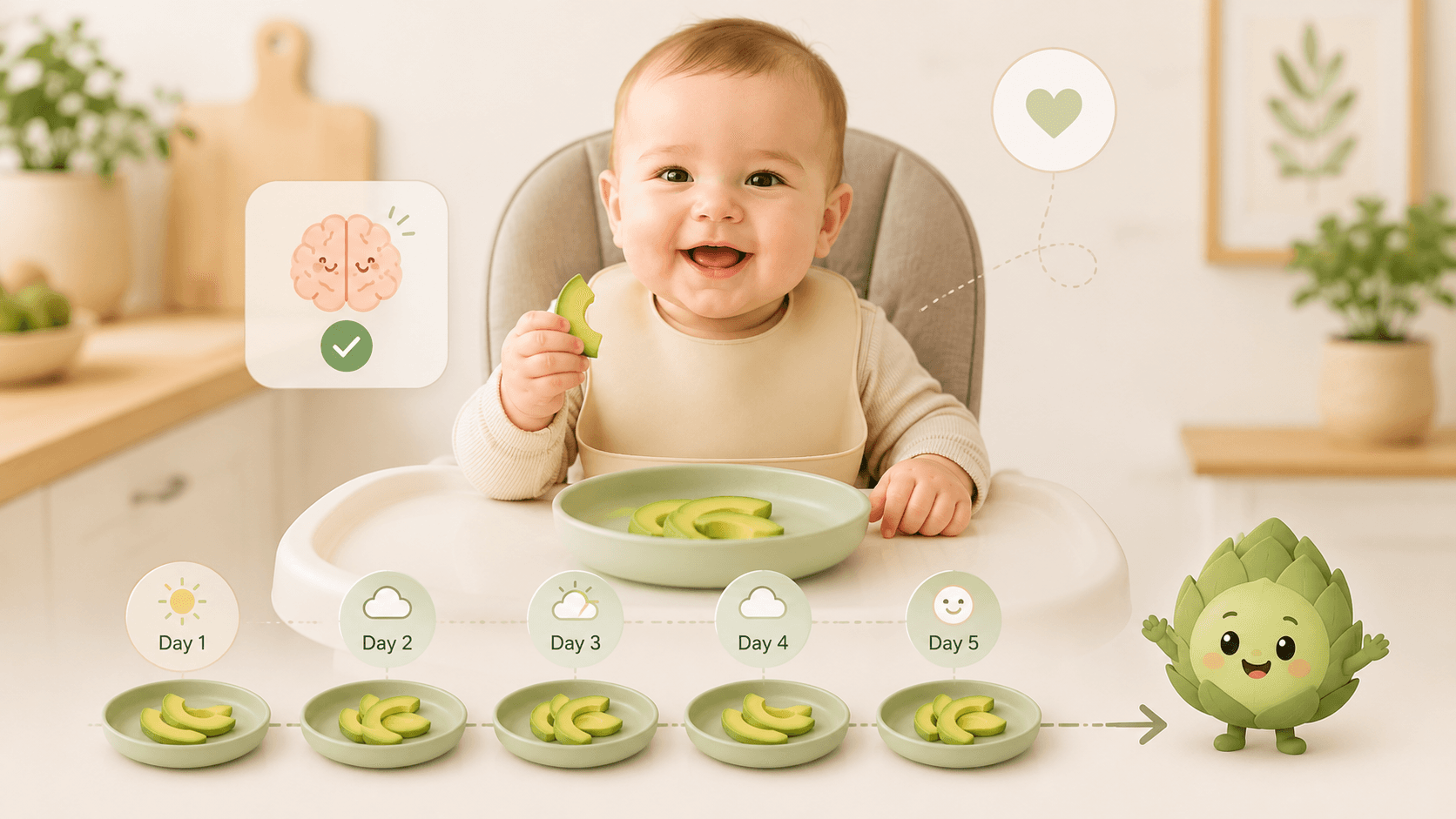
That can happen.
Sometimes babies prefer familiar foods. Sometimes parents repeat a food because it is easy, available, and safe. Sometimes life is busy.
Repeating one food for a few days does not ruin your baby’s progress.
You can gently add variety by making tiny changes:
same food, different shape
same food, different texture
same food with a new dip
same food paired with one new food
same food served at a different temperature
Example:
Banana
Day 1: banana spear
Day 2: mashed banana
Day 3: banana with oatmeal
Day 4: banana rolled in ground oats
Day 5: banana with plain yogurt
That is still progress.
What if baby refuses new foods?
Refusal is normal.
A baby may turn away, make a face, drop food, or ignore it completely. That does not always mean they dislike it forever.
Try to avoid pressure.
Instead:
offer a small amount
keep your face calm
let baby explore
model eating the food yourself
try again another day
track the exposure so you remember it happened
Pressure can make meals stressful. Calm repetition can make food feel familiar.
How YumYum can help
When you are building variety slowly, tracking becomes very useful.
YumYum helps you remember:
which foods your baby tried
how many times they tried each food
whether there was a reaction
which foods you want to try next
how your baby’s variety grows over time
You do not need to keep everything in your head.
With YumYum, you can see that small meals are still adding up.
Download YumYum: BLW Baby Food Tracker and start tracking your baby’s first foods today.
FAQ
Does my baby need a different food every day?
No. Your baby does not need a different food every day. Variety is important over time, but repeated foods and simple meals are normal when starting solids.
Is it okay to repeat the same food for my baby?
Yes. Repeating the same food can help your baby become familiar with taste, texture, smell, and shape.
Can one food be enough for a baby meal?
Yes. In the beginning, one soft, safe food can be enough. Starting solids is about learning as well as nutrition.
What if my baby only eats the same food?
That can happen. Keep offering safe foods without pressure and slowly add variety over time. If your baby has ongoing feeding difficulties or you are worried about intake, speak with your pediatrician.
How do I build food variety for my baby?
Start with simple foods, repeat familiar options, and gradually add new foods from different categories such as fruits, vegetables, grains, iron-rich foods, and healthy fats.
Should I offer one food at a time?
You can start simply, especially when introducing common allergens or watching for reactions. Over time, mixed meals are fine when foods are prepared safely and your baby tolerates them.
Are solids mainly for practice at first?
Solids are both practice and nutrition. Babies learn important feeding skills while also beginning to get nutrients from food. Around 6 months, solid foods become part of your baby’s complementary feeding journey.
Should I track my baby’s first foods?
Tracking can help you remember what your baby tried, how often they tried it, and whether there were any reactions. YumYum helps organize this process.
Learn more in our First 100 Foods Guide
If you are just starting solids, read our BLW First Foods Guide
To choose safe textures by age, visit our Safe Serving by Age